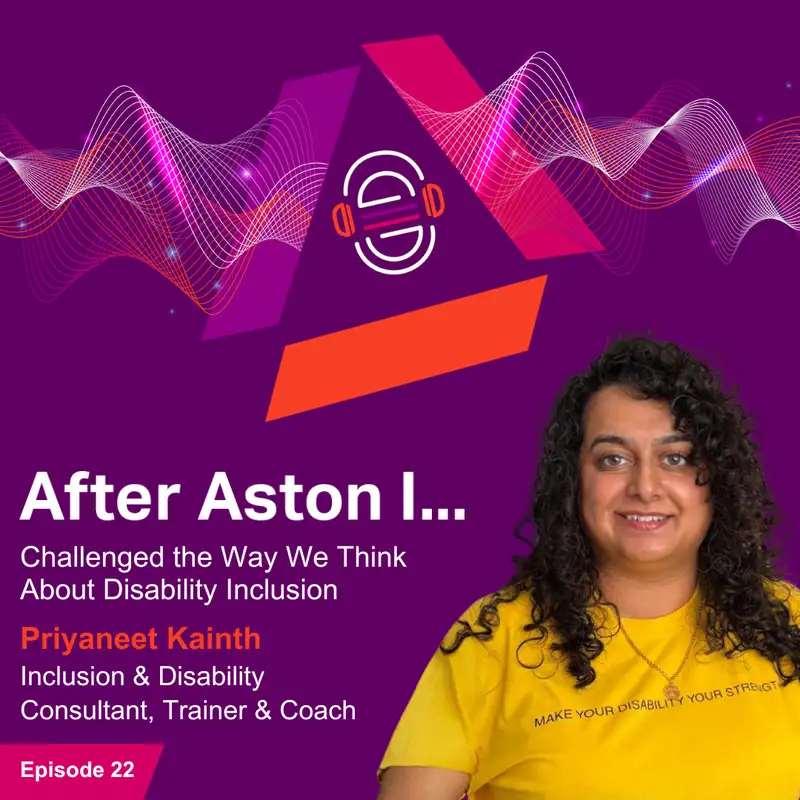
After Aston I… challenged the way we think about disability inclusion
After Aston — Season 3, Episode 2: Priyaneet Kainth
*This transcript has been edited for brevity and clarity.*
Priyaneet Kainth:
I turned my pain into my passion and now my passion into my purpose. But that has come over a lot of years of self-love and self-acceptance. I had to go through that to understand who I was, understand my values and my beliefs. Also, being in a South Asian community, for females, you're always told to serve others before you.
Aimee Postle:
Welcome back to After Aston I...
We are into our second episode of season three, and we've got another brilliant Aston alumni story to share with you.
Geoff Savage:
Today we're talking to Aston alumna Priyaneet Kainth about her career in technology, inclusion, culture, belonging, and disability, turning personal experience into meaningful change and what it takes to create a more inclusive workplace.
Aimee Postle:
After graduating from Aston University in 2014 with a degree in Computing for Business, Priyaneet built a successful career spanning technology, business transformation, coaching, and global inclusion and belonging, and is now an independent disability inclusion consultant and coach.
Drawing on her professional experience and her own journey as a South Asian woman living with an invisible disability, she became a passionate advocate for people with disabilities, establishing disability networks and championing more inclusive workplaces.
Geoff Savage:
Now, after more than a decade in the corporate world, Priyaneet has taken the leap into entrepreneurship. As an inclusion and disability consultant, speaker, trainer, and qualified coach, she helps organizations remove barriers, develop inclusive leaders, and create workplaces where people with disabilities can join, stay, progress, and thrive.
Priyaneet, it's great to have you with us. Welcome to the After Aston podcast.
Priyaneet Kainth:
Thank you so much, Geoff and Aimee, for a warm welcome. I'm really looking forward to having a conversation with you about my life after Aston.
Geoff Savage:
You graduated from Aston in 2014 with a degree in Computing for Business. Can you talk us through your journey since then? How did you get to where you are today?
Priyaneet Kainth:
When I explain it to people, it sounds like going from one extreme to another.
When I was at Aston, my programme included a placement year. I started my career at GlaxoSmithKline in Coleford, based at a manufacturing site that made Lucozade and Ribena. My role there was site technician lead, literally rebuilding Windows 7 laptops and making sure all the IT on the factory floor was maintained and managed. That ranged from TVs on the production line to telephones—literally A to Z.
I loved that job. I didn't imagine myself in that world, but I learned a lot about people and problem-solving. On a manufacturing site, you're so close to the product the organization creates, understanding the process and the challenges they face.
After I graduated, my primary thought was, "I don't want to be jobless." I got a role as an intern at Deutsche Bank in Birmingham, and I stayed there four years across different roles. I started in reconciliation, which was okay, but I preferred change management, creative products, and innovation. That's when I applied for a job as a business analyst.
Before moving into that role, I worked in production support within compliance IT. As a test manager, I was writing test scripts, putting in testing best practices and standards, and implementing testing systems for the team.
After a year or so, I moved into the business analyst role. That shifted me from technical language—writing scripts and working with developers—to working directly with stakeholders and business owners to understand their problems, identify solutions, and translate those into requirements. I learned a lot about Agile coaching and loved being around people.
After that, I moved back to GlaxoSmithKline in manufacturing, this time in Maidenhead at a site producing Sensodyne toothpaste. Again, I served as site tech delivery lead, implementing technology to strengthen production processes.
While there, I led one of my biggest projects: a quarter-million-pound initiative to upgrade the entire site security system, from new wiring and vetting vendors to onboarding teams. The biggest lesson I learned was that people will forget cost—whether you go under or over budget—and people will forget time, but people will never forget quality. That lesson stuck with me for the rest of my career.
Next, I moved into tech transformation at GSK as an Agile coach for the consumer healthcare function, working with product teams and managers to develop their ways of working. We trained them on principles called Value Flow Quality: understanding how teams deliver value to consumers quickly while maintaining quality. I loved training, coaching, and mentoring.
I spent about three years in that space. In 2021, I stepped into the role of Global Inclusion and Belonging Manager. GlaxoSmithKline demerged its consumer healthcare function into a standalone global company called Haleon, and I served as the global inclusion manager. Setting up a standalone global company, defining the inclusion strategy, and building employee resource groups was a unique, foundational experience.
Alongside that corporate work, I also did voluntary work with Muscular Dystrophy UK. I'm very fortunate for the variety of roles I've held and everything I learned through them.
Aimee Postle:
That is a brilliant overview, Priyaneet.
Going back to the beginning: in terms of the placement year you did while at Aston, how did that shape your confidence and your ability to step into that graduate role?
Priyaneet Kainth:
It shaped me completely. It was the first time I moved away from home. As a South Asian woman living with a disability, moving away from home was not the traditional norm, and my parents had a lot of worries.
It helped me grow personally, academically, and professionally. I learned about myself, what I didn't want, and what the corporate world was like.
Having the support of Aston University made a huge difference. When you first step into the corporate world, it's scary. I remember when my tutor visited site for my placement presentation; it showed me that Aston was still standing by me. When I experienced tough moments with my health on placement, Aston was right there supporting me.
Aimee Postle:
You took on a number of moves throughout your career that weren't necessarily the roles you originally targeted, but they were the opportunities that opened up. What was your mindset going into a completely unfamiliar role?
Priyaneet Kainth:
I got a mentor. I was always advised to find a mentor outside of my immediate team to guide me.
When I was offered the test manager role, my heart had been set on being a business analyst. My manager encouraged me: "Take this opportunity, embrace it, and learn." Having that mentor helped me stay open to opportunities that didn't fit my exact plan. Through that role, I developed strong problem-solving skills, patience, and attention to detail.
Aimee Postle:
Looking back, do you see the common thread of people, culture, and inclusion across those positions, even when they were tech-focused?
Priyaneet Kainth:
Definitely. Even in technical roles, everything came down to people. I was communicating globally with teams in India and the US. Tech was simply the enabler to give people what they needed.
I also observed workplace culture closely: How inclusive are we? How are we showing up for the disabled community? If an organization didn't have a disability network or community, I set one up, whether at Deutsche Bank or GSK. That voluntary community building is really where my inclusion journey started.
Geoff Savage:
Have you noticed a gap between the messaging some companies put out about inclusion and what they actually deliver to their workforce?
Priyaneet Kainth:
Most companies have good intentions. A business is built on people, and a diverse workforce reflects your customer base, driving creativity and inclusion.
The companies I worked with took action to back up their words, but diversity encompasses a vast breadth of characteristics, so prioritization is key. Moving from leading a voluntary disability network to managing global strategy over the past five years was a major shift for me.
We all carry unconscious biases. As an Indian woman with a disability, it's easy to look through a personal lens and ask, "Why aren't we focusing on this?" Stepping into a strategic leadership role forced me to look at the bigger picture: business strategy, geopolitical factors, the economy, and legal requirements.
It's one thing to host awareness events; it's another to embed inclusion into organizational DNA, policies, and operational frameworks while honoring people's lived experiences.
Inclusion cannot remain a standalone HR initiative. It is everyone's responsibility. My role was holding up the mirror to leaders and saying, "This is what you're committed to doing—now let's take it further."
Aimee Postle:
I love the question you asked yourself: "Who and what am I in service of? Am I doing this for my ego, or for the greater good?" That is such a powerful coaching question.
Priyaneet Kainth:
Everything we do is in service of something bigger. My purpose is to serve others: to help people realize their potential and to open doors for the disabled community.
To lead effectively, I had to look inward and examine my motivations. A couple of years ago, I qualified as an executive coach and completed my master's degree. That self-reflection helped me understand my trajectory.
Each role taught me what I loved and what I didn't want, bringing me closer to where I am today. At the end of the day, it's not about job titles or money—it's about the opportunities you create for others.
Aimee Postle:
Qualifying as a coach requires learning deeply about yourself before you coach others.
You've spoken openly about living with a disability. Can you share how your lived experience has shaped your perspective, and how qualifying as a coach influenced that journey?
Priyaneet Kainth:
I live with an invisible, degenerative condition called Charcot-Marie-Tooth disease type 4C. It is a rare motor and sensory peripheral neuropathy affecting the nervous system.
It causes muscular dystrophy, meaning muscle wasting throughout my body. I also have a mild form of cerebral palsy affecting my wrists and ankles, leading to weak grip, poor dexterity, and weak coordination. My ankles are very weak, so I wear specialized ankle supports and custom insoles, and I have to wear trainers 24/7. Without shoes, I cannot walk properly.
I also have scoliosis, a curvature of the spine, and dysarthria, which impacts my speech and leaves me prone to voice fatigue and chest infections in the winter. In 2019, when I was working as an Agile coach, the voice fatigue worsened significantly, impacting how I communicated in my day-to-day work. In noisy environments, I cannot project my voice easily.
Because of the sensory neuropathy, I have poor balance and lack sensation. If I cut myself while preparing food or bruise myself in a fall, I often don't feel it until I see blood or a mark.
Because I don't use a wheelchair full-time, people often assume nothing is wrong. I've had strangers challenge me when parking in accessible bays with my blue badge, saying, "That's a disabled bay," simply because my disability isn't immediately visible.
I sum up my lived experience in three words: turning pain into passion, and passion into purpose. Reaching that stage took years of self-acceptance.
Growing up in a South Asian community, women are often taught to prioritize everyone else's needs first. When I considered enrolling in my coaching qualification, self-doubt crept in: "Should I spend this money? What if I need it for a rainy day?" I had to rewrite those limiting beliefs and push through fear.
The coaching training taught me far more than techniques—it grounded me in self-awareness, allowing me to show up with greater empathy and perspective for others.
Geoff Savage:
You recently took the leap from the corporate world to launch your own disability inclusion consultancy and coaching practice. Was that self-discovery through coaching the catalyst for taking that step?
Priyaneet Kainth:
Yes. The qualification provided the professional ethics and coaching framework, but the inner work gave me the confidence to trust that I had the capability within myself to do this.
Geoff Savage:
Was stepping away from the corporate environment intentional, or did it happen naturally?
Priyaneet Kainth:
It was entirely intentional. I always knew I wanted to run a business, inspired by my grandparents. My maternal and paternal grandparents were both entrepreneurial. My grandfather was a manufacturer and tailor creating high-visibility jackets and clothing. Growing up, I helped out at his shop on weekends, checking stock and sweeping the floors, dreaming of becoming a businesswoman one day.
The second factor was my health. Charcot-Marie-Tooth is a slowly progressive condition. I reflected on what I wanted my life and energy to look like as I grew older. The corporate world gave me incredible experience, but I knew that if I didn't try entrepreneurship now, I would regret it.
I asked myself, "What's the worst that can happen?" If it doesn't work out, I can always return to a corporate role. But my qualifications, experience, and network gave me the foundation to take the leap.
I promised myself I would be an advocate for the disabled community. Accessibility matters for all of us because as we age, mobility changes. While we are in positions of influence, we have an obligation to make society inclusive.
Aimee Postle:
Tell us more about your business. How do you work with organizations to make a tangible difference?
Priyaneet Kainth:
I help organizations build confident, inclusive workplace cultures through consulting, training, keynote speaking, and coaching, blending my corporate background with my lived experience.
On the consulting side, I partner with organizations to build comprehensive inclusion, diversity, and belonging strategies. We analyze workforce data, benchmark priorities, and ensure their internal culture reflects their consumer base.
I deliver disability inclusion training covering language, workplace adjustments, psychological safety, and legal frameworks like the Equality Act. We also look at talent pipelines: recruitment practices, retention, and career progression for disabled employees.
Another key focus is Employee Resource Groups. Having established global frameworks for ERGs covering disability, race, gender, and LGBTQ+ communities in my corporate career, I help organizations structure, mature, and localize their networks to drive business value.
On the coaching side, I offer inclusive leadership coaching, workplace coaching for disabled professionals navigating adjustments, and life and health transition coaching. When individuals receive a new diagnosis or experience changing health symptoms—as I did with voice fatigue—it brings emotional and physical shifts. I help them navigate that transition.
Through keynote speaking, I share my journey while leaving audiences with practical actions. Real transformation requires engaging both the head and the heart: pairing policy, frameworks, and metrics with human empathy and lived experience.
Aimee Postle:
Managing physical symptoms like voice fatigue means you have to be intentional about where you spend your energy. How do you balance speaking, client delivery, and your health?
Priyaneet Kainth:
People don't always see the energy management required behind the scenes. After speaking engagements, I often need dedicated vocal rest.
The work fuels my purpose, but it can also be physically demanding. I manage my schedule intentionally. I love food and travel, so I make time for experiences that replenish my energy.
I've learned to listen to my body, prioritize rest, and pace myself. Life isn't a flat line; it has peaks and troughs, and navigating those shifts gives you perspective.
Geoff Savage:
What advice would you give to recent graduates navigating the early stages of their careers, managing expectations, and planning their next steps?
Priyaneet Kainth:
First: be curious and remain a student for life. When you stay hungry to learn, opportunities follow. If you aren't sure what direction to take, dive in, explore, and learn through doing.
Second: believe in yourself. You have the capability within you to grow, succeed, and support those around you.
Third: enjoy the journey and stay present. I love the quote: "If you are depressed, you are living in the past. If you are anxious, you are living in the future. If you are at peace, you are living in the present." Focus on the moment in front of you.
Geoff Savage:
To wrap up, we have our quick-fire questions. First: what is your favorite Aston memory?
Priyaneet Kainth:
The people! The friends and connections I made along the way, many of whom are lifelong friends today.
Aimee Postle:
If you could have anyone, past or present, in your corner on your team, who would you choose?
Priyaneet Kainth:
Maya Angelou. I love her writing, her wisdom, and the way she helped people find their voice and inner confidence. Reading her work feels like a warm hug.
Aimee Postle:
That is a wonderful answer. Priyaneet, thank you so much for joining us on After Aston and sharing your journey.
Priyaneet Kainth:
Thank you both for having me on the podcast. I really enjoyed the conversation!
Aimee Postle:
We will include links to Priyaneet's LinkedIn and website in the show notes.
Geoff Savage:
If you'd like to share your own story, visit the Aston for Life platform to explore more inclusion content and alumni features.
Aimee Postle:
Thank you for listening. That's the latest from After Aston I...
Geoff Savage:
We'll see you soon!
Creators and Guests