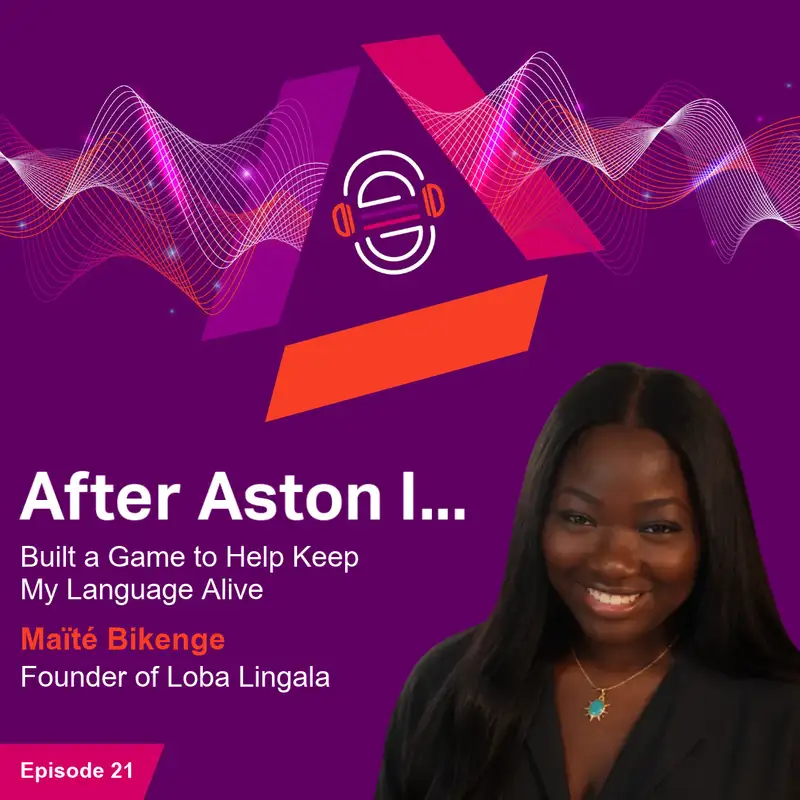
After Aston I...built a game to help keep my language alive
After Aston I... — Season 3 Episode 21: Maïté Bikenge
*This transcript has been edited for brevity and clarity.*
Maïté Bikenge:
I want to make sure that I'm building something that's authentic and culturally accurate. How I've done that is I've pulled in native reviewers—people like my dad, people in my family who are fluent—just to make sure that the community's involved in making sure that I'm not putting out content that's inaccurate.
Not knowing Lingala and just thinking about the kind of person that I want to be and the kind of things that I want to pass on to my future children, that's definitely shaped my experience in building the game.
Aimee Postle:
Welcome back to the After Aston I... podcast for series three. It is great to be back, Geoff!
Geoff Savage:
It really is. It's been a little while. I like a long summer break as much as anyone, but it really is going to be fantastic to be back hearing some more wonderful stories about what Aston graduates have gone on to do.
Aimee Postle:
Absolutely, and we've got another really interesting story to share, as today we're joined by Maïté Bikenge.
Geoff Savage:
Maïté graduated from Aston in 2019 with a master's in international relations and global governance. Since then, she's built a career in privacy compliance and digital product delivery. She's now a senior privacy analyst at Warner Bros. Discovery, where she's led privacy compliance work supporting the expansion of HBO Max across 78 territories.
Alongside her career, Maïté has taken on a very different challenge—one that has a much more personal connection. Growing up hearing Lingala but never learning to speak it herself, she wanted to find a way to reconnect with the language and make it easier for others in the Congolese diaspora to do the same.
That led to Loba Lingala, a game-based platform that helps people learn Lingala through play, conversation, and culture. What's particularly fascinating is that Maïté built the platform without a technical background, using AI alongside native speakers and the Congolese community to develop and test the content.
What started as a very personal project has now reached people in more than 30 countries. It's a great example of what can happen when you have an idea that matters to you and decide to give it a go.
It's an absolute pleasure to have you here with us today. Welcome to the After Aston I... podcast.
Maïté Bikenge:
Thank you so much for having me. That was a great introduction as well, so thank you. I appreciate it. I'm pleased to be reconnected with Aston, albeit virtually, but I'm happy to share what I've been up to since leaving.
Aimee Postle:
Amazing. Well, I'm going to jump straight in if that's okay. For someone who hasn't come across Loba Lingala before, can you talk us through what it actually is? If I went on the platform today, what would I experience? How would I work my way through the gamification?
Maïté Bikenge:
Loba Lingala means "speak Lingala," and it's a game that I've created to help people learn Lingala. Lingala is an African language which is widely spoken in the Democratic Republic of Congo. It's estimated to be spoken by around 40 million people.
I created the game particularly aimed at people like me—people in the diaspora who may have grown up hearing the language, but were never confident speaking it.
The main game is a flashcard-style memory game, so you learn words by matching them to their meanings, and it's meant to be a fun way to build your vocabulary. However, there are different ways to learn as well. There are different categories that cover everyday phrases and traditional proverbs, so you're not just learning individual words, but you're also getting a feel for how the language is actually used.
Beyond the game, there are features that help you practice speaking as well, so you can hear pronunciation, record yourself, and compare how you do with that. I've also built in a translation feature where you can enter something in any language and figure out how to say it in Lingala.
One important thing for me was accessibility—making sure that everyone can access this. So the game is free. You just type in the link on your web browser and you can play the game.
Aimee Postle:
That sounds absolutely amazing. Your users could be all over the world—connected to, but disconnected from, their heritage. What makes somebody want to come back and learn the language? What makes them engage with the game?
Maïté Bikenge:
In terms of what makes someone want to come back and learn the language: if you play Duolingo, for example, you have streaks, which can be quite aggressive sometimes. I've been intentional in making my gaming experience calm and intentional.
It's about feeling no pressure, so you have a space where you feel like, "Okay, I can come here, practice, and get back in touch with my heritage without feeling like there's pressure to do it a certain way."
I wanted to create that atmosphere, and I've also really honed in on community. I've built a social media following where I post about the game, and people who have played it leave comments like, "It's great that we have this!"
When they've tried to find resources, they've tried mainstream ones like Duolingo, and they just haven't seen something that serves them. The fact that they can see something that works for them within my game is something that keeps people coming back. That's been quite reflective in the feedback I've received, just honing in on that community aspect.
Geoff Savage:
You've spoken about growing up hearing Lingala but not learning to speak it yourself. Has that experience shaped the idea behind the game?
Maïté Bikenge:
Yeah, for sure. It's definitely shaped the kind of person that I want to be. Getting older and not knowing how to speak my language—and living in the UK, exposed to multiple cultures—there's every chance that I may not end up marrying someone who's Congolese.
I've seen it within my own family: a lot of people are marrying outside our culture, which is fine, but it's important to make sure that we are doing what we can to preserve the culture and pass it on.
Not knowing Lingala, thinking about the kind of person I want to be, and the things I want to pass on to my future children—that's definitely shaped my experience in building the game.
Geoff Savage:
And what was the moment, if there was one, where you thought, "I'm going to do this. I'm going to build this"? Or did it grow gradually?
Maïté Bikenge:
I think it grew. It was me thinking, "I'm at an age where I can't speak the language. Yes, my parents had a hand in that when I was younger by not encouraging me to speak it, but now I'm at an age where I can take accountability for my own development, so let me do something about it."
I went looking to find a way to learn, and I didn't find anything I found interesting enough. I really didn't want to sit down and study a textbook or watch a YouTube video; I wanted it to be a fun thing. The fact that I couldn't find something made me think, "You know what? I'm just going to build it myself." And now we're here.
Geoff Savage:
When you started that process, did you tell people in your family, or did you wait for a dramatic reveal?
Maïté Bikenge:
I definitely told people in my family. I started with my dad, because we have four national languages in Congo, and my dad speaks all of them fluently, plus English and French. I figured he'd be the best person to speak to about it and get input from.
I told him, "This is what I want to do. What do you think?" And he was like, "Yeah, go for it."
I also spoke to my partner about it, who's not Congolese—he's Nigerian. Being Nigerian, he mentioned that they have so many resources for people who want to learn their languages, and I was really inspired by that.
I spoke to those two first and foremost, and as I've been building it, I've been slowly revealing it to more and more people.
Geoff Savage:
Did your idea of what it might be or could be change as you went along?
Maïté Bikenge:
Yes, for sure. The early version I created—the very early MVP—is nowhere near what it looks like today.
When I had the idea to build it, I literally went to Claude, which was my AI tool of choice, told it what I wanted to create, and asked it to create something basic. When it created it for me, with me being non-technical and it doing it so quickly, I was very impressed. I thought that was the best thing ever!
But when I presented it to my younger brother, he was not as impressed as I was and was able to spot things that I didn't spot. When you're building something, you have a vision and know how you want it to work, but if you give it to someone with no context, they likely won't understand how you want it to work. Getting that feedback from my brother was very important.
Geoff Savage:
That's what younger brothers are for, isn't it?
Maïté Bikenge:
Exactly—to bring me back to reality!
Aimee Postle:
You could have created something more traditional. What led you to say, "I'm going to gamify this and turn it into a game rather than a traditional language learning app"?
Maïté Bikenge:
With traditional resources—because there are some resources where you can learn Lingala in a traditional sense—I wanted this to be effective, and I wanted people to come back to it.
We all know Duolingo is highly gamified and people tend to be addicted to it—people are always going back to Duolingo. I wanted something similar, though not as addictive. I really want people to learn and get value from the game.
I wanted to create something fun where people would come back to it. Having something on my phone that's easily accessible and part of my culture gives me a sense of pride. Having a game that represents Congolese culture gives me that feeling, so that was my thought process behind it.
Aimee Postle:
How do you go about building a sense of community with Loba Lingala's users?
Maïté Bikenge:
At the moment, I've been trying to put on events where I invite people interested to get a live demo of Loba Lingala—so you can come in, learn some Lingala, play the game, test it, and give me feedback. You also get to connect with other people.
I'm very intentional about creating an experience where people can connect, honing in on that community aspect.
On social media via TikTok, I'm always trying to get input from people and put that into the game. Even in the early days when I created the MVP, I dropped the link into a WhatsApp group of Congolese people, asked them to test it and give feedback, and incorporated that into the game.
I'm big on using the community to shape it. Knowing this is about language, it's important that even though I can technically just use AI to translate all these words into Lingala, I want to make sure I'm building something authentic and culturally accurate.
How I've done that is pulling in native reviewers—people like my dad and fluent family members. I've also communicated with a linguistics professor from Ghent University who has worked in Lingala for many years, asking him to review the content to make sure I'm not putting out inaccurate content. That's really important for me.
Aimee Postle:
Are those community members people you knew already, or did those networks develop because you started building this?
Maïté Bikenge:
It's been both. I started with people I knew already, like my dad and family members. From there, it's grown to include people I've met along the way.
For example, the Congolese community group chat I mentioned—I didn't know too many people in it initially, but when I put the product in the chat and people saw it and liked it, they were more than happy to be involved and support in any way.
Even at the event I hosted back in July, a few people gave me their emails and said, "If you need help developing it into an app or need help with product strategy, just let me know."
It's been really good. People seeing the value in the product has made them want to support it, and I'm very grateful for the community support I've received so far.
Aimee Postle:
I noticed you've been shortlisted for a number of awards, identified as an inspiring icon, and involved in employee resource groups and the UK Black Tech community. How has being part of those communities helped your confidence in developing this?
Maïté Bikenge:
The recognition I've received by being part of those communities—with people recognizing that I'm all about accessibility—has given me confidence. I like to create opportunities and make sure people have access to different things in different ways.
Getting recognized for that has given me the confidence to keep going. It's also been helpful to leverage the networks and platform I've gained through those opportunities.
There's a similar theme running across all of them: being part of my employee network group at work, building Loba Lingala, and being on the board of Black in Tech UK. The key theme for me is making things accessible for people who may not always have the opportunity to be in those rooms. I'm definitely using what I'm exposed to in those networks to help build my game.
Geoff Savage:
You mentioned that human input remains vital. You started off with AI as the initial building block, but you don't come from a technical computing background. That sounds like an ideal version of how AI can be used—not relying on it entirely. Was that an added bonus as you went through?
Maïté Bikenge:
Definitely. It's very easy to assume that if you ask AI something, you just accept the output. AI is capable of breaking and hallucinating, so it's very important that even though you can use AI to build something quickly, you should always rely on human input and remain the decision-maker.
Throughout this process, I've learned that AI is not perfect. There are steps you need to implement to make sure what you're building is reliable, and it's never going to be 100% reliable because of how it's built. Having human input and being intentional about it was really important for me.
One other thing I found interesting: mainstream AI tools tend to train their data on Western data, so I found translations were often quite off. Because of that, I intentionally looked for AI tools specifically built with the African context in mind.
I came across one built by a developer in Kenya named Calvin Rono. The AI tool is called Daraja, and that's actually one of the tools I use in the game to power the translation feature.
No AI tool is 100%, but because it's built with the African context in mind and uses data from the African continent, the translations are far more reliable. I've been really pleased and proud to include that in my game.
Geoff Savage:
Has combining real-world human input with technology been relatively smooth, or has that been where most of the work lies?
Maïté Bikenge:
That has been where most of the work lies—it hasn't been smooth at all!
With the feedback I've received, some suggestions—like requests for pronunciation in a native accent—are very difficult to achieve with limited resources unless you have significant funding.
Mainstream AI tools aren't trained on African contexts, so accessing native accents is unlikely. When it comes to African accents, everything is nuanced—they're not the same depending on which country or region you're in.
These are things I've had to struggle and compromise with, making do with what's available to me. But it's something I'm always thinking about, learning about, and speaking to people about to make the game as good as possible.
Aimee Postle:
There's a focus on languages at risk of disappearing. When you started this project, how much responsibility did you feel about keeping your language alive for future generations?
Maïté Bikenge:
Initially, I felt less pressure; I feel more pressure now than I did in the beginning! Initially, I didn't expect it to take off as well as it has.
I have access to analytics and can see that the game is being played in Congo, which is very interesting to me. Their reasons for playing are likely different from someone in the diaspora, but the fact that I built it with the diaspora in mind and people back home are playing it and returning to it often blew my mind.
I feel this is something I need to do, especially seeing the feedback and requests for the game to expand to the four national languages. Lingala is the most commonly spoken, but many people in the diaspora don't speak the other three languages. I feel a responsibility to champion Congolese languages.
Aimee Postle:
Has feedback made you step back and say, "Wow, I'm making a difference here"?
Maïté Bikenge:
Yes, for sure. People who aren't Congolese but have Congolese children have said they're happy this exists because now they can connect with their child's culture and be involved in passing it on, which I find really touching.
There have also been calls for me to create a product more tailored toward children, as children learn differently than adults. When building Loba Lingala, I built it for adults in the diaspora. The calls for a children's resource have been encouraging and touching.
Aimee Postle:
Do you identify as an entrepreneur?
Maïté Bikenge:
Not yet! It's something I aspire to be, but I don't think I'm quite there yet.
I'm someone who typically did everything as expected: school, GCSEs, A-levels, university, nine-to-five job. This is my first time doing something unconventional. I've been learning a lot, and I feel I still have a lot to learn about business and entrepreneurship.
It's something I aspire to be and am enjoying. When I was at school, I wish there was more emphasis that entrepreneurship is an option for you, because it's been a very steep learning curve for me.
Aimee Postle:
I ask with a vested interest because my teaching background is working with entrepreneurial students here at Aston University, and we always debate whether people see themselves as entrepreneurs or just as people making an impact somewhere. The word "entrepreneur" seems difficult for people to grasp hold of.
Geoff Savage:
You mentioned the traditional nine-to-five route—school, university, good grades, stable job. You have a career in privacy compliance and digital project delivery at a large multinational scale. Has that experience influenced the way you approached Loba Lingala?
Maïté Bikenge:
It's been quite scary because I've seen two sides of the same coin.
Delivering a product at work, I have a team to help pick up slack and contribute ideas where I have weaknesses, so everyone complements each other to deliver the product.
Building Loba Lingala, I've mainly been doing it myself, wearing many hats: product, marketing, privacy, and security. I've had to be adaptable and stretch myself in ways I didn't think possible.
If it wasn't for my day job, I don't think I would have built a product with robust security and privacy features in mind. I've seen others who code products miss those aspects, which slows product delivery. Because of my day job, I leveraged that experience to make sure my product was built responsibly regarding people's data. That's been a very fun aspect of building the product.
Geoff Savage:
Do you want a team around you in the longer term?
Maïté Bikenge:
I do, because I do not like social media! As soon as I'm able to, I am outsourcing my marketing and social media. My personal social media is very bare, so putting myself out there has been uncomfortable. I do it because I understand its importance, but I'm not enjoying it.
Geoff Savage:
It takes energy that you could be using elsewhere.
Maïté Bikenge:
That is exactly my issue. I want to focus on the product and delivering the product. If someone else could pick up marketing and social media, it would be amazing.
I've observed that the content that performs best is the video with my face in it—the video I really didn't want to do! People connect with a person and a story, so for now, I'm happy to step into that role for the product, but eventually I would like to work behind the scenes.
Geoff Savage:
What would you say to someone listening who has an idea they're passionate about, but keeps telling themselves, "I'm not technical enough, experienced enough, or qualified enough"?
Maïté Bikenge:
I would say: just do it! You lose more time talking yourself out of something than if you just do it and figure things out along the way.
I had no technical expertise, but I had a pain point and decided to address it. Now I've reached thousands of users, met all sorts of people, and ended up in rooms I didn't think I'd be in—all because I decided to just do it.
Go for it, and you'll figure it out along the way.
Geoff Savage:
Thank you so much. Now, as always, we finish up with our quick-fire questions. Aimee, do you want to kick us off?
Aimee Postle:
What was your favorite Aston memory?
Maïté Bikenge:
My favorite Aston memory was when I was selected to represent the Aston team at EuroSim, a model simulation of the European Union where you debate policies.
I was someone who thought I was quite average and didn't think I'd do anything extraordinary. Someone seeing potential in me was a special moment. We went to Belgium and got to see the European Union back when we were still part of it!
Aimee Postle:
Geoff, your question.
Geoff Savage:
If you could have anyone, alive or dead, join you on the Loba Lingala team, who would it be?
Maïté Bikenge:
I'm going to choose Lupita Nyong'o. I envy her storytelling—she's so good at telling stories about African culture, identity, and heritage. I need someone on the team who can talk about Loba Lingala and bring it to life!
Aimee Postle:
Final question: What is one Lingala word or phrase everyone listening should learn today?
Maïté Bikenge:
*Malembe*, which means "slowly." Life gets busy, and it's a good reminder to take things slowly, little by little. You say it twice: *malembe, malembe*.
Aimee Postle:
*Malembe, malembe*. Love it! Maïté, it has been fascinating hearing your story and the story behind Loba Lingala. Thank you so much for giving us your time.
Maïté Bikenge:
Thank you so much for having me. I really enjoyed sharing my story, and I hope it inspires anyone listening.
Aimee Postle:
We will leave the links to Maïté's LinkedIn and Loba Lingala in the show notes. Geoff, tell us about the Alumni Club.
Geoff Savage:
A quick reminder: the Alumni Club is open Monday to Friday, 9:30 to 5:00, right in the heart of Birmingham. We've launched a new program of events from recent graduate meetups to talks with alumni experts. Follow us on social media to keep up to date with everything happening at the Alumni Club.
Creators and Guests